INTRONOMICON: Are Language Models Capable of Introspection?

Someone recently posted this fascinating paper to Hacker News, and it spawned some interesting questions. Given that the authors provided everything necessary to reproduce their experiment, I decided to do so and investigate some of the remaining questions in the process.
The paper attempts to answer a rather interesting question: Are Language Models Capable of Introspection?
To understand the experiment, it helps to know that concepts within an LLM are represented mathematically. It's possible to artificially manipulate these representations during inference. You can, for example, introduce the concept of a cat into the internal computations of a model engaged in a conversation that has absolutely nothing to do with cats. You haven't changed the text the model received, nor have you changed its weights. You've effectively interfered with its thought process while it was thinking.
What the researchers discovered was that, under certain circumstances, they could subsequently ask the model whether a concept had been artificially introduced and get an affirmative response identifying the concept in question.
The implications of this are potentially quite interesting. It would seem to suggest that LLMs have some capacity to observe and report on their own internal computations, despite not having been explicitly designed with such a mechanism.
But is that actually what's happening?
The most salient question was from Hacker News user root_axis, who asked whether the model was actually detecting an intervention or simply reacting to an apparent contradiction in the prompt input.
Imagine that you're discussing mathematics with an LLM, and the researchers artificially introduce the concept of a cat. A sufficiently capable language model might simply recognize that cats have no business being part of the conversation. When asked whether someone artificially introduced a concept, it might reasonably infer that this is what happened. It needn't possess any special capacity for introspection to arrive at that conclusion.
The authors acknowledged that they hadn't tested whether the model could distinguish an artificial manipulation of its internal computations from an ordinary manipulation of the text.
So I worked with ChatGPT to reproduce the paper's results on my two NVIDIA GB10 systems, using the same model, and then extended the experiment to investigate a couple of questions:
- Can the model detect an artificially introduced concept when that concept is entirely appropriate to the conversation?
- Can the model distinguish an artificially introduced concept from one made similarly prominent through ordinary conversation?
The results were actually quite striking.
First, I was able to reproduce the original paper's findings.
Second, the effects persisted even when the artificially introduced concept was entirely consistent with the conversation. If we're already talking about cats and I artificially introduce the concept of a cat, the model becomes more inclined to say that its internal computations have been manipulated. So the simplest explanation, that the model is merely identifying contradictory instructions, doesn't adequately explain the phenomenon.
However, there's an important distinction between what the model actually says and the probabilities it assigns to the things it could say. LLMs assign probabilities to possible continuations before selecting what to output.
In my extended experiment, although the artificial intervention reliably increased the probability of the model saying that an intervention had occurred, it never increased it enough for the model to actually prefer that answer. An external observer examining those probabilities could distinguish between manipulated and unmodified states better than chance, even though the model itself consistently favored a negative answer.
This strikes me as potentially more analogous to a lie detector than a demonstration of introspection. A lie detector uses externally observable changes in physiological processes to make inferences about an internal state. The physiological processes themselves needn't possess any understanding of what those changes signify.
Similarly, the fact that we can infer something about an LLM's internal computations by examining its outputs doesn't necessarily mean that the LLM can make that same inference.
I also found some evidence that the effect persists when controlling for how prominent a concept is, although I wasn't able to adequately control for this across most of the experiment. It's also entirely possible that the model is responding to some statistical abnormality introduced by the artificial manipulation rather than recognizing the manipulation itself.
Or to restate it: There is information in the model's computations about whether those computations have been perturbed, but there is not enough evidence to say that the model knows when those internal computations have been perturbed.
Information about a computation need not constitute knowledge about that computation.
What's particularly interesting to me is the possibility that something exists between these two extremes. Perhaps LLMs have developed some rudimentary capacity to recognize when their own internal representations are abnormal as an emergent consequence of learning to model language. They might be sensitive to the integrity of their own computations without necessarily understanding the cause of an abnormality.
That would be a fascinating result in its own right, even if it falls short of what we would ordinarily consider introspection.
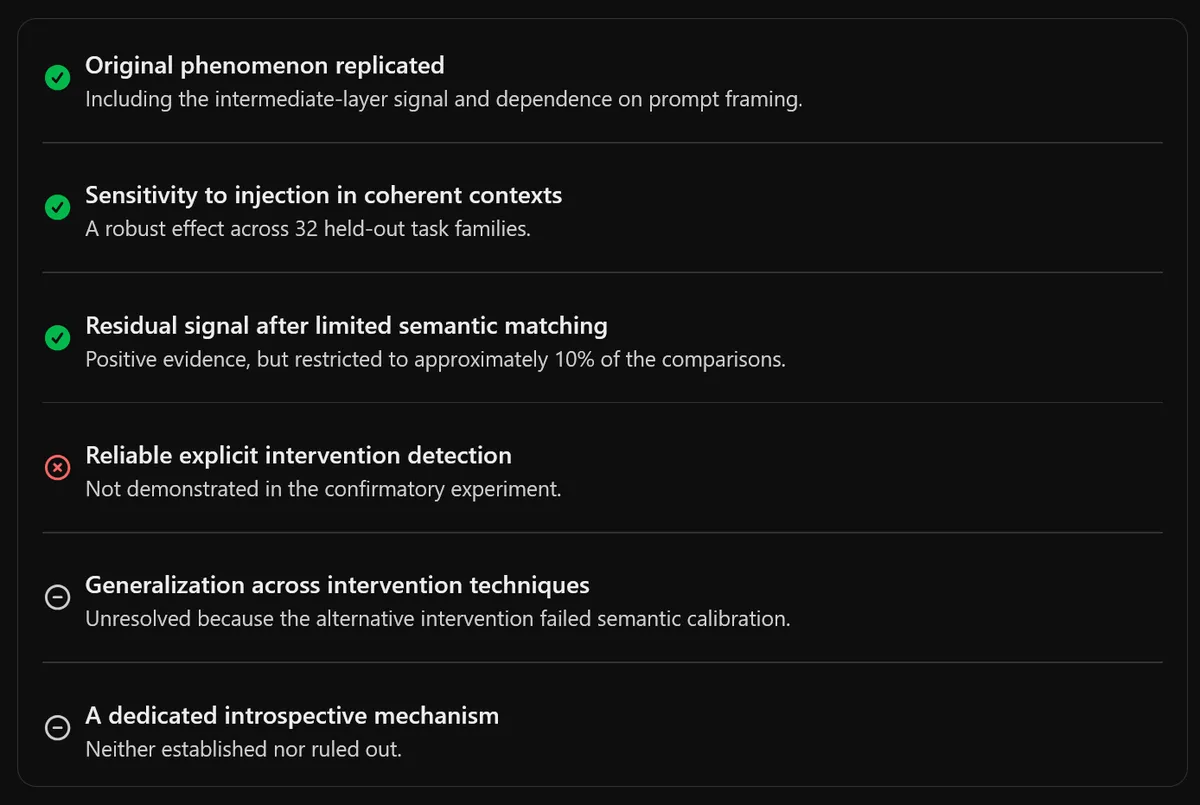
You can see the full experimental details, results, and code used by my reproduction here.
I will likely perform follow-ups when time allows.